
Let’s connect
︎jadforthepeople@gmail.com
︎jadforthepeople@gmail.com
Folio ‘26
︎Download CV
Jad has built his career at the intersection of human-centered design and enterprise strategy — most recently leading AI GTM for Salesforce's Financial Services vertical, where he invented PRISM, built the Experience Strategy Group, and co-architected the JV structures connecting premier financial institutions to pre-market AI. He's drawn to organizations where safety and ambition aren't in tension — where building carefully is the competitive advantage.
When I'm at my best, I feel like I'm continuing the work of the people who shaped how I think: Dave Gray, who taught me to make complexity visible. Bruce Mau, who showed me that design is the act of changing the world. Peter Schwartz, who taught me to see the future as something you architect, not something that happens to you.
Editiorial
#strategicforesigh
#scenarioplanning
#AGI
#enterpriseai
#futures
#responsibleai
#scenarioplanning
#AGI
#enterpriseai
#futures
#responsibleai
On scenario planning, the arrival of AGI, and why the people at the top of the mountain have a responsibility they cannot outsource.
There is a particular kind of meeting that happens inside large enterprises right now, in boardrooms and executive offsites and strategy sessions across every regulated industry in the world. It goes something like this:
Someone puts up a slide. The slide has a timeline. The timeline has milestones. The milestones have owners. The room nods. The meeting ends. And everyone walks out with a document that describes, in careful detail, a future that almost certainly will not happen.
I've been in that room. Many times. And I've spent the last decade trying to figure out how to change what happens in it.
The problem isn't that executives are bad at strategy. The problem is that the tools most organizations use for strategy were designed for a different kind of uncertainty than the one we're in. Roadmaps, forecasts, scenario trees, SWOT analyses — these are instruments calibrated for a world where the future is a more-or-less predictable extension of the present. Add 15% year-over-year. Extrapolate the trend. Model the adjacency.
That model of uncertainty is gone. It has been replaced by something structurally different: a world in which the pace of AI capability development is fast enough to invalidate entire strategic assumptions within a single planning cycle. Not gradually. Abruptly. And we are not at the end of that acceleration. We are somewhere near the beginning of it.
The institutions I work with — global banks, wealth managers, insurers, healthcare enterprises — are not naive about this. Their boards are asking hard questions. Their CDOs and Chief AI Officers are under real pressure to make consequential commitments with incomplete information. The problem isn't that they don't know the future is uncertain. The problem is that they don't have the tools to think usefully about uncertainty at this scale.
That's what scenario planning was built for. And it's what most organizations are not doing.
The goal of a scenario is not to predict the future. The goal is to expand the decision-maker's ability to recognize the future when it arrives — and to have already thought through what they would do if it did.
This is a subtle but profound reorientation. The value of a scenario exercise is not measured by whether the scenario turns out to be right. It's measured by whether it changed the quality of the decisions made in the present. A good scenario is not a forecast. It's a rehearsal.
Most of the strategy work I see in enterprise settings is trying to do the first thing — forecast — when what it should be doing is the second thing — rehearse. The result is organizations that feel prepared because they have plans, but are not actually prepared because their plans assumed a specific future rather than developing the strategic muscles to navigate multiple ones.
The question I get asked most often, in one form or another, is: what should we do first?
It sounds like an execution question. It isn't. It's a foresight question dressed in execution clothing.
The answer depends entirely on which future you think you're in — and on whether you've built the cognitive infrastructure to change that answer when the evidence shifts. Organizations that sequence their AI investments well are not the ones with the best AI strategy documents. They're the ones whose leadership teams have a shared, grounded, regularly stress-tested view of the forces shaping their competitive landscape, and a clear logic for how that view connects to their investment decisions.
Building that shared view is harder than building a roadmap. It requires a different kind of facilitation, a different kind of research, and a different kind of artifact. It requires someone who can walk into a room of senior executives, hold the complexity of genuine uncertainty without collapsing it into false confidence, and help the people in that room think more clearly than they would have without you.
That's the work. It's not glamorous. It doesn't produce a clean deliverable. But when it's done well, it changes how an organization makes decisions — not for a quarter, but for years.
Here is the thing I can no longer avoid saying directly:
AGI is not a thought experiment. It is not a marketing term. It is not a scenario reserved for the speculative fiction section of the futures workshop. It is a near-term technical trajectory that the people building these systems — not futurists, not analysts, the engineers and researchers themselves — believe is measurable in years, not decades.
And when it arrives, the question of whether humanity benefits or suffers will not be decided primarily by the technology. It will be decided by the decisions that were made — or not made — in the years before it arrived. By the governance frameworks that were built, or weren't. By the institutions that chose to lead, or chose to wait. By the technology leaders who understood that being at the top of the mountain is not a position of privilege. It is a position of obligation.
I work with some of the largest financial institutions in the world. These are not abstract stakeholders in the AI transition. They are the infrastructure of economic life for hundreds of millions of people. The decisions their boards and executive teams make about AI adoption — what to build, what to govern, what to refuse — will shape the distribution of AI's benefits and harms at a scale that very few other institutions can match.
When I walk into those rooms, I am not trying to help them win a competitive advantage. I am trying to help them make decisions worthy of the moment they're in.
That is a different brief. It requires a different kind of foresight work — one that takes the full range of futures seriously, including the ones that are genuinely frightening, and helps the people in the room develop the moral and strategic clarity to act well inside them.
The technology leaders at the top of the mountain — the ones with the relationships, the platforms, the distribution, the institutional trust — are not just participants in the AI transition. They are, whether they chose it or not, its stewards.
That stewardship has a specific shape. It means building AI systems that accelerate human capacity rather than replacing human agency. It means designing adoption frameworks that distribute AI's benefits rather than concentrating them. It means being honest about risk in rooms where honesty is inconvenient. It means refusing the comfort of the roadmap when the roadmap is a fiction.
Most importantly, it means doing the futures work seriously — not as an innovation theater exercise, not as a strategy offsite warm-up, but as a genuine practice of collective sense-making at the highest levels of organizational authority.
Innovation, at this moment, is not neutral. It never was. But the stakes are higher now than they have ever been. The same capability that could accelerate human flourishing at unprecedented scale could, deployed without wisdom, without governance, without the hard work of imagining the second and third-order effects — accelerate something much darker.
We do not get to be bystanders. Not at this altitude. Not at this moment.
I don't think the answer is more prediction. I don't think the answer is more roadmaps, more milestones, more timelines that describe futures we've already decided we prefer. I think the answer is better questions, held with more rigor, rehearsed with more honesty, and acted on with more moral seriousness than most organizations currently manage.
The map is not the territory. The forecast is not the future.
But a well-built scenario — built on real signal, stress-tested against second-order effects, held by people willing to sit with the discomfort of genuine uncertainty — is the closest thing we have to a compass.
The people at the top of the mountain did not ask for this responsibility. But they have it. The question is whether they use it.
How might we build the foresight infrastructure — inside the most powerful technology companies and the institutions that depend on them — that converts AI's exponential capability into human acceleration, not human self-harm?
This is foresight work. It is scenario work. It is systems thinking applied to the most consequential inflection point in the history of our species.
It is the work I have been doing.
It is the work I am not finished with.
...
Jad Campbell is a foresight practitioner who builds things. is a scenario designer who has tested his work in the most consequential enterprise boardrooms in the world. is a systems thinker who believes the most dangerous word in strategy right now is "probably." is someone who thinks the people at the top of the mountain owe something to everyone below it.
There is a particular kind of meeting that happens inside large enterprises right now, in boardrooms and executive offsites and strategy sessions across every regulated industry in the world. It goes something like this:
Someone puts up a slide. The slide has a timeline. The timeline has milestones. The milestones have owners. The room nods. The meeting ends. And everyone walks out with a document that describes, in careful detail, a future that almost certainly will not happen.
I've been in that room. Many times. And I've spent the last decade trying to figure out how to change what happens in it.
The problem isn't that executives are bad at strategy. The problem is that the tools most organizations use for strategy were designed for a different kind of uncertainty than the one we're in. Roadmaps, forecasts, scenario trees, SWOT analyses — these are instruments calibrated for a world where the future is a more-or-less predictable extension of the present. Add 15% year-over-year. Extrapolate the trend. Model the adjacency.
That model of uncertainty is gone. It has been replaced by something structurally different: a world in which the pace of AI capability development is fast enough to invalidate entire strategic assumptions within a single planning cycle. Not gradually. Abruptly. And we are not at the end of that acceleration. We are somewhere near the beginning of it.
The institutions I work with — global banks, wealth managers, insurers, healthcare enterprises — are not naive about this. Their boards are asking hard questions. Their CDOs and Chief AI Officers are under real pressure to make consequential commitments with incomplete information. The problem isn't that they don't know the future is uncertain. The problem is that they don't have the tools to think usefully about uncertainty at this scale.
That's what scenario planning was built for. And it's what most organizations are not doing.
The goal of a scenario is not to predict the future. The goal is to expand the decision-maker's ability to recognize the future when it arrives — and to have already thought through what they would do if it did.
This is a subtle but profound reorientation. The value of a scenario exercise is not measured by whether the scenario turns out to be right. It's measured by whether it changed the quality of the decisions made in the present. A good scenario is not a forecast. It's a rehearsal.
Most of the strategy work I see in enterprise settings is trying to do the first thing — forecast — when what it should be doing is the second thing — rehearse. The result is organizations that feel prepared because they have plans, but are not actually prepared because their plans assumed a specific future rather than developing the strategic muscles to navigate multiple ones.
The question I get asked most often, in one form or another, is: what should we do first?
It sounds like an execution question. It isn't. It's a foresight question dressed in execution clothing.
The answer depends entirely on which future you think you're in — and on whether you've built the cognitive infrastructure to change that answer when the evidence shifts. Organizations that sequence their AI investments well are not the ones with the best AI strategy documents. They're the ones whose leadership teams have a shared, grounded, regularly stress-tested view of the forces shaping their competitive landscape, and a clear logic for how that view connects to their investment decisions.
Building that shared view is harder than building a roadmap. It requires a different kind of facilitation, a different kind of research, and a different kind of artifact. It requires someone who can walk into a room of senior executives, hold the complexity of genuine uncertainty without collapsing it into false confidence, and help the people in that room think more clearly than they would have without you.
That's the work. It's not glamorous. It doesn't produce a clean deliverable. But when it's done well, it changes how an organization makes decisions — not for a quarter, but for years.
Here is the thing I can no longer avoid saying directly:
AGI is not a thought experiment. It is not a marketing term. It is not a scenario reserved for the speculative fiction section of the futures workshop. It is a near-term technical trajectory that the people building these systems — not futurists, not analysts, the engineers and researchers themselves — believe is measurable in years, not decades.
And when it arrives, the question of whether humanity benefits or suffers will not be decided primarily by the technology. It will be decided by the decisions that were made — or not made — in the years before it arrived. By the governance frameworks that were built, or weren't. By the institutions that chose to lead, or chose to wait. By the technology leaders who understood that being at the top of the mountain is not a position of privilege. It is a position of obligation.
I work with some of the largest financial institutions in the world. These are not abstract stakeholders in the AI transition. They are the infrastructure of economic life for hundreds of millions of people. The decisions their boards and executive teams make about AI adoption — what to build, what to govern, what to refuse — will shape the distribution of AI's benefits and harms at a scale that very few other institutions can match.
When I walk into those rooms, I am not trying to help them win a competitive advantage. I am trying to help them make decisions worthy of the moment they're in.
That is a different brief. It requires a different kind of foresight work — one that takes the full range of futures seriously, including the ones that are genuinely frightening, and helps the people in the room develop the moral and strategic clarity to act well inside them.
The technology leaders at the top of the mountain — the ones with the relationships, the platforms, the distribution, the institutional trust — are not just participants in the AI transition. They are, whether they chose it or not, its stewards.
That stewardship has a specific shape. It means building AI systems that accelerate human capacity rather than replacing human agency. It means designing adoption frameworks that distribute AI's benefits rather than concentrating them. It means being honest about risk in rooms where honesty is inconvenient. It means refusing the comfort of the roadmap when the roadmap is a fiction.
Most importantly, it means doing the futures work seriously — not as an innovation theater exercise, not as a strategy offsite warm-up, but as a genuine practice of collective sense-making at the highest levels of organizational authority.
Innovation, at this moment, is not neutral. It never was. But the stakes are higher now than they have ever been. The same capability that could accelerate human flourishing at unprecedented scale could, deployed without wisdom, without governance, without the hard work of imagining the second and third-order effects — accelerate something much darker.
We do not get to be bystanders. Not at this altitude. Not at this moment.
I don't think the answer is more prediction. I don't think the answer is more roadmaps, more milestones, more timelines that describe futures we've already decided we prefer. I think the answer is better questions, held with more rigor, rehearsed with more honesty, and acted on with more moral seriousness than most organizations currently manage.
The map is not the territory. The forecast is not the future.
But a well-built scenario — built on real signal, stress-tested against second-order effects, held by people willing to sit with the discomfort of genuine uncertainty — is the closest thing we have to a compass.
The people at the top of the mountain did not ask for this responsibility. But they have it. The question is whether they use it.
How might we build the foresight infrastructure — inside the most powerful technology companies and the institutions that depend on them — that converts AI's exponential capability into human acceleration, not human self-harm?
This is foresight work. It is scenario work. It is systems thinking applied to the most consequential inflection point in the history of our species.
It is the work I have been doing.
It is the work I am not finished with.
...
Jad Campbell is a foresight practitioner who builds things. is a scenario designer who has tested his work in the most consequential enterprise boardrooms in the world. is a systems thinker who believes the most dangerous word in strategy right now is "probably." is someone who thinks the people at the top of the mountain owe something to everyone below it.
#ai_gtm
#prism
#financial_services
#hcd
#research
#salesforce
#2024
#prism
#financial_services
#hcd
#research
#salesforce
#2024
A top 3 bank in North America wanted to be first. They came to Salesforce and Microsoft with the same ask: design a pilot that would produce insights, results, an innovation architecture, and a three-year roadmap. We ran Human-Centered Design workshops across 26 user groups and 12 cities. And then the problem arrived — every line of business had completely different needs. No shared center. No obvious universal play.
We couldn't win the fight that was in front of us. So we built an agent to find the one we could win.
The result was PRISM — now Salesforce's official AI prioritization framework across every industry. And a $64M TCV deal. We beat Microsoft.
How we found what every banker actually needed
We couldn't win the fight that was in front of us. So we built an agent to find the one we could win.
The result was PRISM — now Salesforce's official AI prioritization framework across every industry. And a $64M TCV deal. We beat Microsoft.
How we found what every banker actually needed
Media

#ai_gtm
#joint_venture
#innovation_architecture
#financial_services
#research
#salesforce
#2024
#innovation_architecture
#financial_services
#research
#salesforce
#2024
The world's largest banks are under enormous pressure to lead on AI. The risk of getting it wrong — regulatory exposure, data governance failure, reputational damage at institutional scale — is equally enormous. In that environment, a demo doesn't close a deal. Trust does.
The Joint Venture model is built for exactly that tension. It starts with a senior leader whose charter is to accelerate the business through AI, and it ends with a blended Innovation Factory running a continuous engine from proof of concept to enterprise capability. Along the way, the bank gets pre-market access to AI functionality that doesn't exist yet. Salesforce's AI Research team gets something equally rare: real-world production data from the most regulated environments on earth.
How we structure the deal nobody else can offer
The Joint Venture model is built for exactly that tension. It starts with a senior leader whose charter is to accelerate the business through AI, and it ends with a blended Innovation Factory running a continuous engine from proof of concept to enterprise capability. Along the way, the bank gets pre-market access to AI functionality that doesn't exist yet. Salesforce's AI Research team gets something equally rare: real-world production data from the most regulated environments on earth.
How we structure the deal nobody else can offer
Media

#ai_gtm
#innovation_architecture
#platform_strategy
#financial_services
#enterprise_ai
#salesforce
#2023
#innovation_architecture
#platform_strategy
#financial_services
#enterprise_ai
#salesforce
#2023
Genie. CDP. Salesforce GPT. Agentforce. Four names. One product. Three years. The platform story was incoherent, the sales teams were cannibalizing each other's mindshare, and customers — understandably — had no idea what they were buying or why it would change their business.
AI isn't a feature you turn on. It's the emergent capability of your data and your experience, working together. That meant the platform story had to start above the product layer entirely — with a picture of what the business could become, structured around four cases every C-suite needs to believe before they commit.
The result is Innovation Architecture: The reason pilots become platforms.
The four cases that turn confusion into conviction
AI isn't a feature you turn on. It's the emergent capability of your data and your experience, working together. That meant the platform story had to start above the product layer entirely — with a picture of what the business could become, structured around four cases every C-suite needs to believe before they commit.
The result is Innovation Architecture: The reason pilots become platforms.
The four cases that turn confusion into conviction
Media

#innovation_architecture
#experience_strategy #financial_services
#hcd
#salesforce
#2021
#experience_strategy #financial_services
#hcd
#salesforce
#2021
Professional Services at enterprise scale has a dirty secret: the deal closes, and the vision that sold it quietly evaporates. The executive who championed it moves on to the next fire. The implementation team, excellent at what they do, delivers the software. And somewhere between signed and scaled, the thing that was supposed to transform the business becomes a project plan.
The Experience Strategy Group was the answer to that gap. A design-led innovation practice built inside Salesforce to meet the executive moment, carry it through implementation, and turn a point-in-time contract into a continuous engine for growth. $70M in revenue. 18 months. The methodology is now standard operating procedure for Salesforce's Professional Services teams.
How we built it — and why the gap is the hardest part
The Experience Strategy Group was the answer to that gap. A design-led innovation practice built inside Salesforce to meet the executive moment, carry it through implementation, and turn a point-in-time contract into a continuous engine for growth. $70M in revenue. 18 months. The methodology is now standard operating procedure for Salesforce's Professional Services teams.
How we built it — and why the gap is the hardest part
Media

#ai_gtm
#account_planning
#enterprise_strategy
#management_consulting
#salesforce
#2024
#enterprise_strategy
#management_consulting
#salesforce
#2024
The Salesforce account plan was a spreadsheet. A document engineered to satisfy the FinPlan, not to guide it. Sellers worked backwards from a predetermined number, filled in the arithmetic, filed it, and repeated the exercise every quarter. Sales leadership thought they had signal. Q4 disagreed.
The insight that changed everything: Salesforce wasn't selling SaaS anymore. It was selling platform transformation to the C-suite of the world's largest institutions. Management consulting doesn't end at contract close. Neither should the plan.
Today the methodology lives in official Salesforce onboarding and across nine public Trailhead Trails. What started as a fix for a broken spreadsheet is now how Salesforce teaches the world to sell.
From first-grade arithmetic to enterprise-wide vision
The insight that changed everything: Salesforce wasn't selling SaaS anymore. It was selling platform transformation to the C-suite of the world's largest institutions. Management consulting doesn't end at contract close. Neither should the plan.
Today the methodology lives in official Salesforce onboarding and across nine public Trailhead Trails. What started as a fix for a broken spreadsheet is now how Salesforce teaches the world to sell.
From first-grade arithmetic to enterprise-wide vision
Media

#brand_strategy
#brand_design
#business_design
#global
#launch
#2020
#brand_design
#business_design
#global
#launch
#2020
The American Health Care system is broken, and Cigna recognized that their acquisition of Express Scripts was an opportunity to cast off old clay and start over, this time with humans at the center, and a bold message for the Health Insurance industry—we are here to do what y’all don’t, won’t, or can’t.
Health is the starting point of human potential. Without it, we can’t innovate, strive for more, or design our ideal future. So strap in, and keep up. We’re moving onward.
Learn about the birth of Evernorth
Health is the starting point of human potential. Without it, we can’t innovate, strive for more, or design our ideal future. So strap in, and keep up. We’re moving onward.
Learn about the birth of Evernorth
Media

#innovation
#design_thinking
#consulting
#rapid_prototyping
#experience_design
#2015
#design_thinking
#consulting
#rapid_prototyping
#experience_design
#2015
The line between hardware and software is hard to trace, and breaking new products has become less a function of filling an unmet need, and more about plugging into a node of a ubiquitous ecosystem: Alexa, Google Assistant, Android and iOS, Peloton, Fitbit – which software does your wearable work with?
So when one of the world’s most skilled hardware crafters approached us about securing their future, we began by finding them a doorway into the largest product pipeline ever created. Inspired heavily by the Spike Jonze masterwork Being John Malkovich (1999).
Get weird with Lenovo
So when one of the world’s most skilled hardware crafters approached us about securing their future, we began by finding them a doorway into the largest product pipeline ever created. Inspired heavily by the Spike Jonze masterwork Being John Malkovich (1999).
Get weird with Lenovo
Media

News, Cigna
TL;DR IPG RFP FTW FKA AOR
#leadership
#design_ops
#marketing_ops
#transformation
#global
#2021
#design_ops
#marketing_ops
#transformation
#global
#2021
Imagine a jungle-thick field of acronyms, and your prize for deciphering them was a dollar amount with 8 zeroes in it. That’s about as close as I can get to a concise explanation of what it was like running Cigna’s largest re-org and vendor selection program in over a decade.
When I landed at Cigna, I found a marketing function that ran two distinct ecosystems: Cigna ran with an AOR (McCann) and supplemented with internal Creative teams; Express Scripts worked primarily with their own internal Creative teams, and supplemented with dozens of niche agencies. Further even, over a hundred shadow marketing vendors served far-flung business leaders, creating varying degrees of off-brand tactics without the benefit of plugging into the stream of work that was already being done. By virtue, this system was inconsistent, and had challenges ensuring quality of work, and brand integrity.
Alongside our new CMO, I defined a new research-based model, hired a search consulting firm—Burnett Collective, they were awesome to work with—and rounded up a group of Marketing, Comms/PR, and Strategy leaders to put something new in place: A bespoke agency crafted specifically to fit our needs by one of the big 4 holding companies.
The majority of what ensued next is tangled under many layers of NDA’s, but the outcome was that IPG, the owner of our former AOR (McCann), beat out the competition, and fielded a team that blended talent and leadership from R/GA, MRM, Craft, and Initiative. Same holding company, new faces, mission, and operating model.
In the end, we slashed our way through the jungle, and the view from the other side looks lush, and full of potential.
When I landed at Cigna, I found a marketing function that ran two distinct ecosystems: Cigna ran with an AOR (McCann) and supplemented with internal Creative teams; Express Scripts worked primarily with their own internal Creative teams, and supplemented with dozens of niche agencies. Further even, over a hundred shadow marketing vendors served far-flung business leaders, creating varying degrees of off-brand tactics without the benefit of plugging into the stream of work that was already being done. By virtue, this system was inconsistent, and had challenges ensuring quality of work, and brand integrity.
Alongside our new CMO, I defined a new research-based model, hired a search consulting firm—Burnett Collective, they were awesome to work with—and rounded up a group of Marketing, Comms/PR, and Strategy leaders to put something new in place: A bespoke agency crafted specifically to fit our needs by one of the big 4 holding companies.
The majority of what ensued next is tangled under many layers of NDA’s, but the outcome was that IPG, the owner of our former AOR (McCann), beat out the competition, and fielded a team that blended talent and leadership from R/GA, MRM, Craft, and Initiative. Same holding company, new faces, mission, and operating model.
In the end, we slashed our way through the jungle, and the view from the other side looks lush, and full of potential.
Media
Case, Edward Jones
From Wall to Main to Easy.
#experience_strategy
#enterprise_web
#consulting
#transformation
#experience_design
#2019
#enterprise_web
#consulting
#transformation
#experience_design
#2019
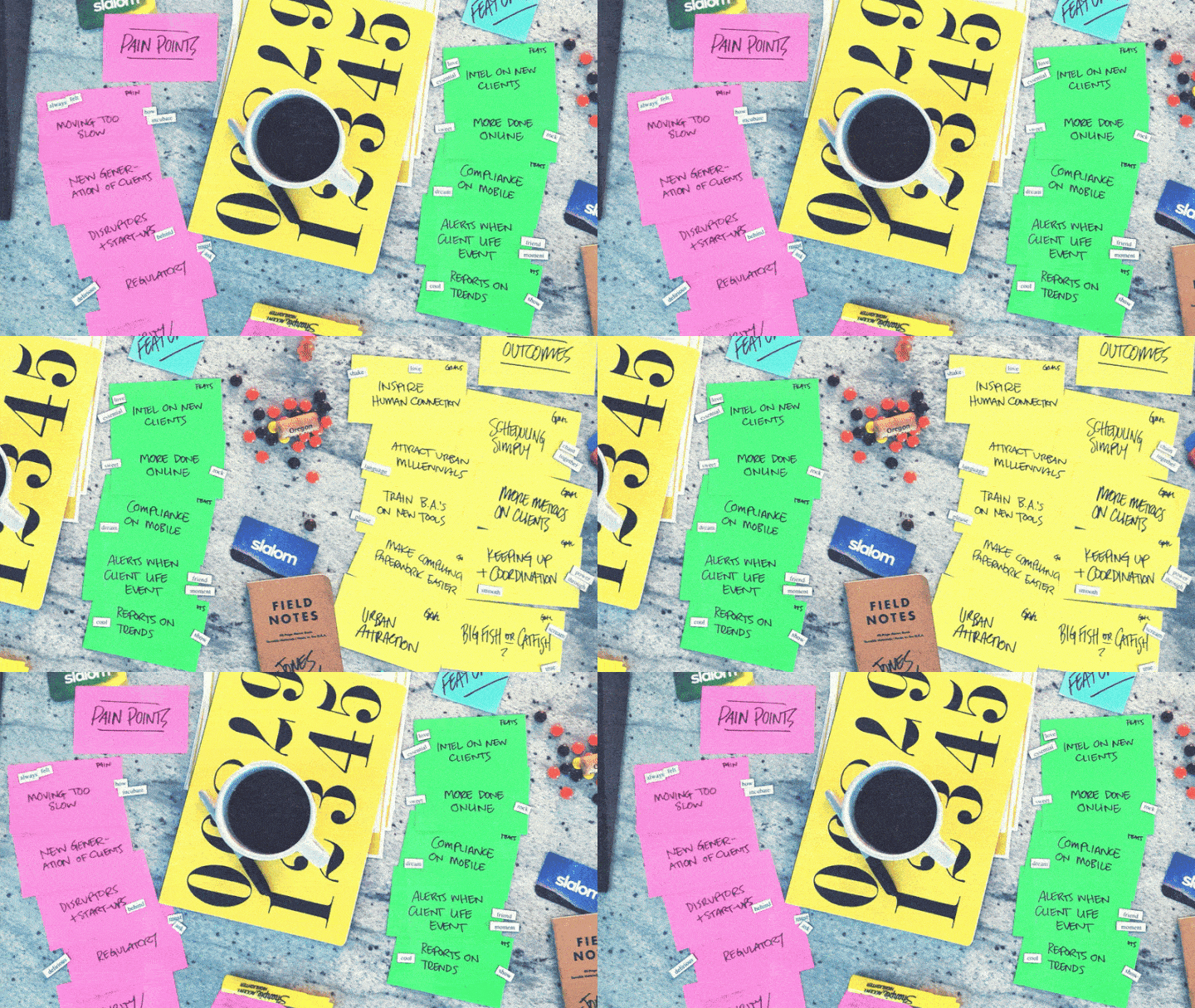
Edward Jones has prided itself on being more Main Street than Wall Street, providing the average american with access to financial stability and a prosperous vision of the future, all cemented through a handshake across the threshold of their 6-panel exurban front door.
And like many other vestiges of the Second Industrial Revolution, that version of the American Dream has aged like absolute milk. Over the last 20 years, phenomena like robotrading, retail investing, generational despair, and superstonks have revealed there’s much more occupying the space between Millennnial investors and their financial advisors than a sensible mahogany desk and complimentary mints.
Helping Ed Jones get personal
And like many other vestiges of the Second Industrial Revolution, that version of the American Dream has aged like absolute milk. Over the last 20 years, phenomena like robotrading, retail investing, generational despair, and superstonks have revealed there’s much more occupying the space between Millennnial investors and their financial advisors than a sensible mahogany desk and complimentary mints.
Helping Ed Jones get personal
Media
#brand_strategy
#brand_design
#service_design
#pharma
#rebrand
#2021
#brand_design
#service_design
#pharma
#rebrand
#2021
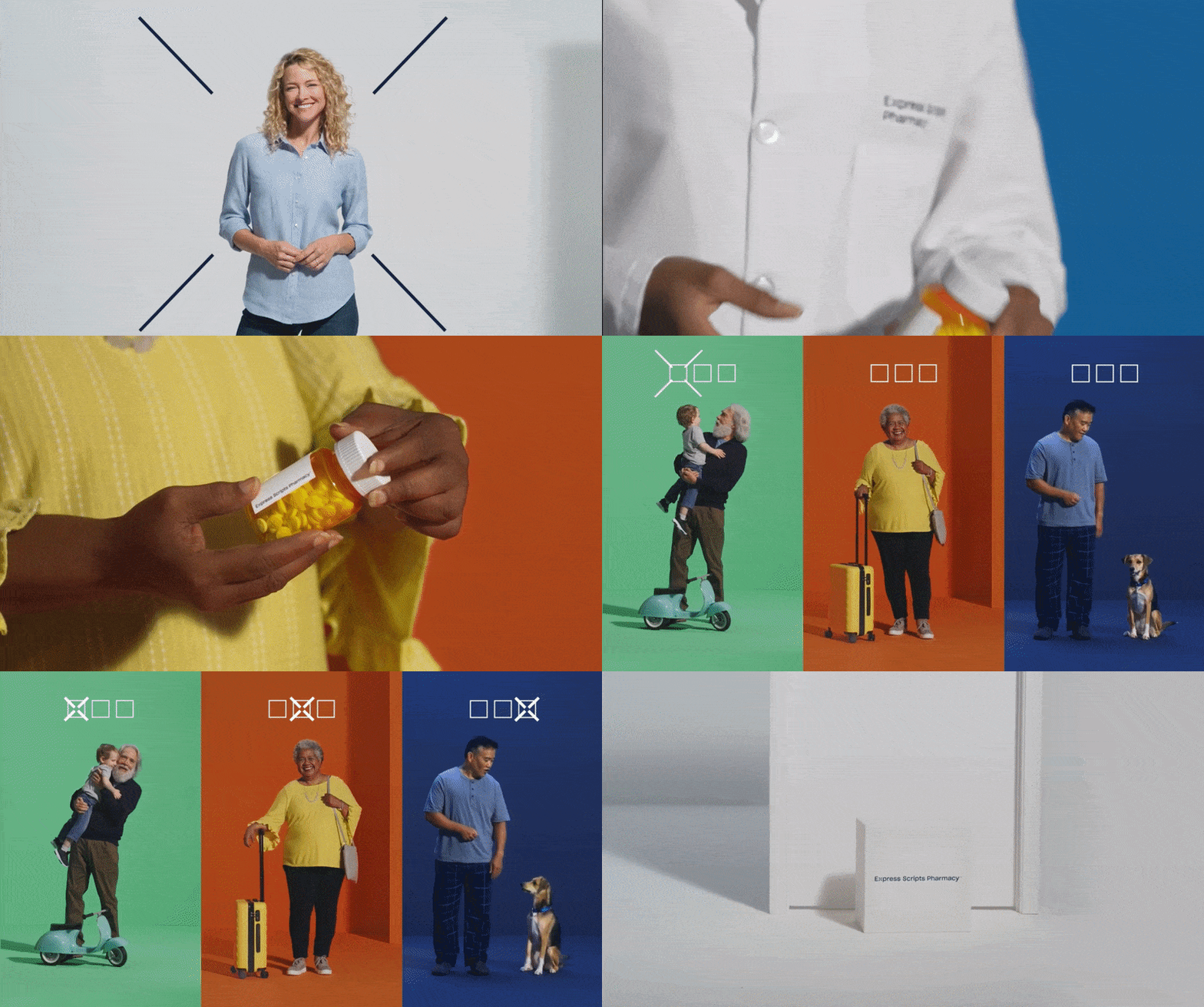
Pharmacists didn’t go to college for 8 years just to ring out your late night Haribo fix at the back register. Like software engineers, their work, when done effectively, should be invisible. The practice of pharmacy keeps you, the patient in this hypothetical riff, safe from violent and potentially deadly drug interactions, allergic shock, and free of fraud and price gouging—so you can get busy, get better, or be more yourself while doing both.
The same is not true of brands: they fundamentally fail unless their impact is seen and recognized. That’s why we took the task of rebranding the 2nd largest consumer pharmacy on Earth to a place where customers came face to face with the actual people under all of those white coats.
Meet the new Express Scripts Pharmacy
The same is not true of brands: they fundamentally fail unless their impact is seen and recognized. That’s why we took the task of rebranding the 2nd largest consumer pharmacy on Earth to a place where customers came face to face with the actual people under all of those white coats.
Meet the new Express Scripts Pharmacy
Media
#graphic_design
#illustration
#screenprinting
#non-profit
#nationalparks
#contest
#illustration
#screenprinting
#non-profit
#nationalparks
#contest
Typehike is an organization that exists to bolster funding for our National Parks through the power of art and beauty, so we can all get out more into the wilderspaces of our country. They generate hundreds of thousands of dollars by engaging with artists and illustrators to create posters and design objects, then they sell the design products and donate all profits to the NPS. The resulting work has been exhibited in galleries all over the world, and even has a permanent installation at The Library of Congress.
To celebrate the St. Louis Gateway Arch, an iconic work of Midcentury modern design from Eero Saarinen, becoming our nation’s 60th National Park, Typehike held a friendly contest among their 60 curated artist partners—to design a fan favorite poster commemorating Saarinen’s catenary arch.
60 artists. 1 winner.
Check out the design (spoiler: I won)
To celebrate the St. Louis Gateway Arch, an iconic work of Midcentury modern design from Eero Saarinen, becoming our nation’s 60th National Park, Typehike held a friendly contest among their 60 curated artist partners—to design a fan favorite poster commemorating Saarinen’s catenary arch.
60 artists. 1 winner.
Check out the design (spoiler: I won)
Media
